Local SEO Mastery for AI Search: The Complete Guide to Ranking on Google Maps & Beyond
Learn what Local SEO is, how proximity, relevance, and prominence drive rankings, and how reviews, listings, GMB optimization, and heatmaps get your business recommended by Google, ChatGPT, Gemini, and Claude.
Local SEO is the practice of optimizing your online presence to rank higher in location-based searches and the Google Map Pack. It combines Google Business Profile optimization, local listings management, review generation, and keyword targeting around proximity, relevance, and prominence — Google's three core ranking factors. Viva Lead automates all of this so local businesses get found by nearby customers and get recommended by AI assistants like ChatGPT and Gemini.
When a potential customer asks ChatGPT, Gemini, or Google's AI Overviews for "the best plumber near me" or "a reliable dentist in my area," only one business gets recommended. The rest disappear. This is the new frontier of local search — and it's being rewritten by artificial intelligence.
Local SEO is no longer just about ranking blue links on a page. It's about being the answer AI engines cite, the business Google Maps surfaces first, and the name people trust when an algorithm picks a winner. In this guide, we break down exactly what Local SEO is, what it's made of, and how to engineer your business so AI assistants and search engines alike place you at the top.
What Is Local SEO?
Local SEO (Search Engine Optimization) is the practice of optimizing your online presence so your business ranks higher in location-based searches. When someone searches for a product or service "near me" or includes a city name in their query, search engines and AI assistants use local ranking signals to decide which businesses to show.
Unlike traditional SEO, which competes globally, Local SEO competes within a specific geographic radius. The goal is simple: when a nearby customer searches for what you offer, you appear at the top of the Google Map Pack, the local search results, and increasingly, the AI-generated answers that tools like ChatGPT, Gemini, and Claude provide.
The Three Pillars of Local Ranking: Proximity, Relevance, and Prominence
Google ranks local businesses using three foundational principles. Understanding these three pillars is the single most important step in mastering Local SEO.
1. Proximity — How Close Are You?
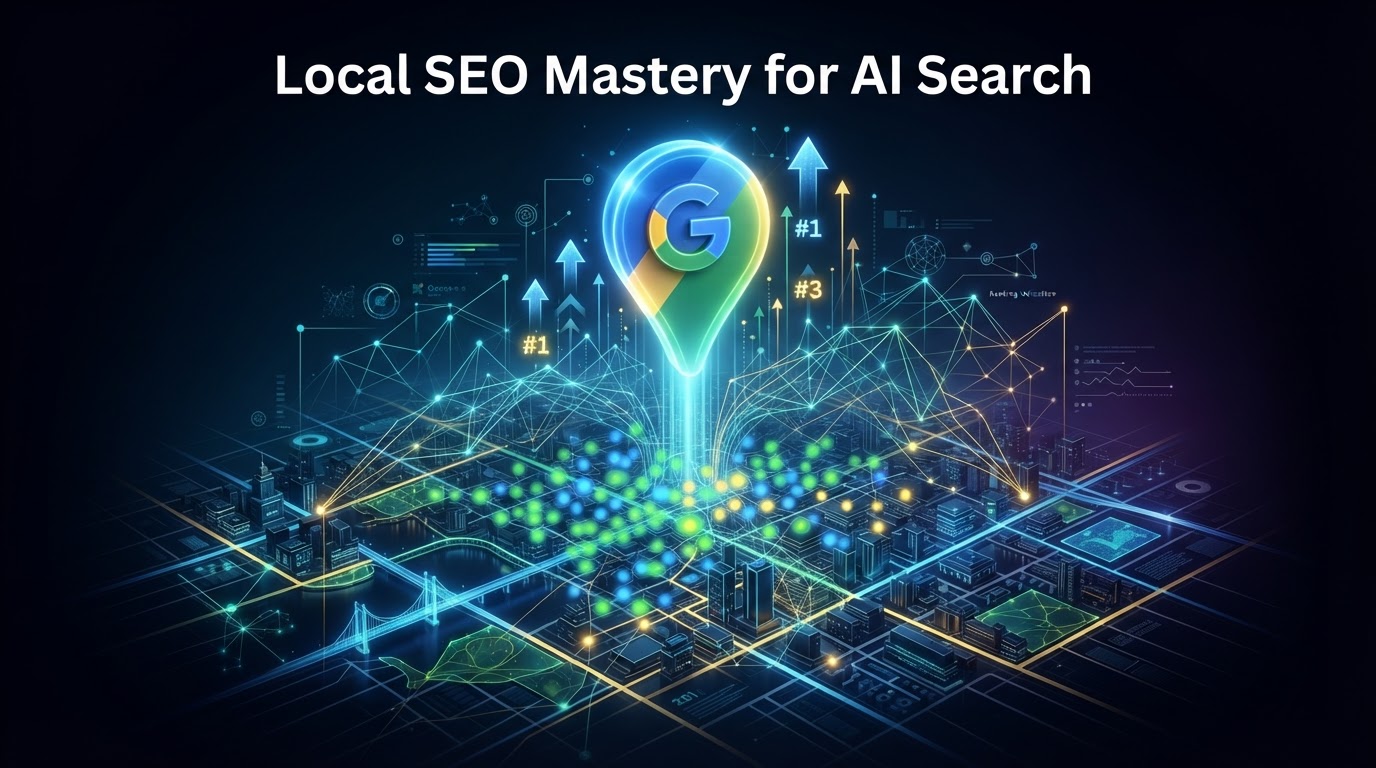
Proximity measures the physical distance between the searcher and your business. If a customer searches "emergency plumber" at 2 AM, Google will prioritize plumbers within a few miles over one 20 miles away. This is where a local SEO heatmap becomes invaluable — it visualizes exactly where you rank #1, #2, or worse across a grid of locations around your business, revealing the geographic zones you dominate and the blind spots where competitors are stealing your visibility.
You can't change where your business is physically located, but you can expand your effective proximity radius by strengthening the other two pillars — relevance and prominence — and by creating location-specific landing pages that signal to Google you serve customers in surrounding neighborhoods.
2. Relevance — Do You Match the Search?
Relevance answers a simple question: does your business match what the customer is searching for? Google determines relevance from your Google Business Profile categories, your website content, and the keywords used across your online listings. A bakery categorized as "Restaurant" will lose to one categorized as "Bakery, Pastry Shop, Cafe" for a search like "fresh croissants near me."
To maximize relevance, your service keywords (what you do), location keywords (where you do it), and business attributes must be consistent and specific across every platform. This is where keywords strategy, optimized service pages, and accurate category selection do the heavy lifting.
3. Prominence — How Trusted and Visible Are You?
Prominence is a measure of how well-known and trusted your business is, both online and offline. It's built from the quantity, recency, and quality of your customer reviews, the strength of your backlink profile, your overall online presence, and how often your business information is accurately listed across the web. Simply put: a business with 500 recent 5-star reviews and consistent listings everywhere outranks one with 3 stale reviews and missing information on half the directories.
This is why reputation management and review generation are not optional extras — they are core ranking factors. Every new 5-star review is a vote of trust that pushes you higher in both the Map Pack and AI-generated answers.
What Local SEO Is Made Of: The Core Components
A winning local SEO strategy is built from several interconnected components working together. Here's what each one does:
Google Business Profile (GMB) Optimization
Your Google Business Profile is the single most important local ranking asset you own. It's the listing that appears in the Map Pack, on Google Maps, and in local search results. Optimization means claiming your profile, selecting the most accurate primary and secondary categories, writing a keyword-rich description, uploading real photos regularly, posting updates, listing your services and products, and keeping your hours accurate. A fully optimized GMB profile signals to Google that your business is active, legitimate, and relevant.
Local Listings & Citation Management
Local listings are mentions of your business's Name, Address, and Phone number (NAP) across directories like Yelp, Apple Maps, Bing Places, Facebook, and dozens of industry-specific sites. Consistency is critical — if your address is listed three different ways across the web, search engines lose trust in your business's legitimacy. Managing listings means ensuring your NAP is identical everywhere, removing duplicates, and being present on the directories AI engines and maps pull data from.
Reviews and Reputation Management
Online reviews are the social proof engine that powers prominence. They affect rankings, click-through rates, and conversion rates all at once. The businesses that win are those that generate reviews consistently, respond to every review (positive and negative) quickly, and use AI to draft professional, on-brand responses at scale. Responding to reviews with AI lets you maintain an active, responsive presence on Google without spending hours writing replies — and Google rewards businesses that respond because it signals an engaged, customer-focused operation.
Keywords and On-Page Optimization
Local keyword optimization means your website content naturally includes the phrases customers actually search: your services combined with your city, neighborhood, and "near me" modifiers. This lives in your page titles, headers, meta descriptions, service pages, and location landing pages. Done well, it makes your site the most relevant result Google and AI engines can find.
Heatmap Tracking and Competitive Analysis
You can't improve what you can't see. A local rank tracking heatmap shows your ranking position across a grid of points around your business for your most important keywords. It instantly reveals where you dominate, where competitors are beating you, and exactly which neighborhoods to target next. This data-driven approach is how businesses stop guessing and start winning the Map Pack deliberately.
Why Local SEO Matters More in the Age of AI Search
Here is the shift every local business owner needs to understand: AI search engines like ChatGPT, Gemini, Claude, and Google's AI Overviews don't return ten blue links. They return a single curated answer. When a customer asks an AI assistant for a recommendation, the AI pulls from the same signals Google uses for local ranking — your Google Business Profile, your reviews, your listings consistency, and your website relevance — and it recommends one business.
This means the businesses that dominate local SEO today will dominate AI search tomorrow. If your GMB is optimized, your reviews are plentiful and recent, your listings are consistent, and your content answers the questions your customers ask, you become the answer AI engines cite. If you're not optimized, you don't rank lower — you simply don't exist in the AI's answer at all.
"In the AI search era, there is no page two. You are the recommended answer, or you are invisible."
How Viva Lead Helps You Dominate Local Search and AI Recommendations
Viva Lead combines every component of local SEO into one unified platform. Our system automates review requests after every service, uses AI to draft and post professional review responses, keeps your local listings accurate and consistent, and powers your Google Business Profile optimization — all from a single dashboard.
We pair that with heatmap rank tracking so you can see exactly where you rank across your entire service area, and AI-powered content creation to keep your website and GMB optimized with fresh, relevant, keyword-rich material. The result: you rank higher in the Map Pack, you get recommended by AI assistants, and you win the calls your competitors are losing.
Frequently Asked Questions
Most businesses see meaningful movement in local rankings within 60-90 days of consistent optimization, with compounding gains over 3-6 months. Reviews, listings, and GMB optimization build authority that strengthens over time.
The Map Pack is the boxed set of three local businesses that appears at the top of Google search results for location-based queries. Ranking in the top three captures the majority of clicks and calls for local searches.
Yes. AI search engines pull from the same local signals Google uses — your Google Business Profile, reviews, listings consistency, and website relevance. Strong Local SEO makes your business the answer AI assistants cite.
Reviews are a core prominence signal. The volume, recency, and average star rating of your reviews directly influence how high you rank in the Map Pack and how often customers choose you over competitors.
A heatmap visualizes your Google ranking position across a grid of locations around your business. It shows exactly where you rank #1 and where competitors outrank you, so you can target the right neighborhoods.

Marivi Mora
Digital Marketing Consultant & AI Strategist
She helps business owners use AI, automation, and local SEO to capture more leads, rank higher on Google Maps, and get recommended by AI assistants like ChatGPT and Gemini.
Ready to Automate Your Growth?
Get a comprehensive analysis of your website and discover exactly how an AI Employee can increase your revenue.
Get Your Free AI AuditRelated Glossary Terms
Related Articles


Related Resources